1) The Fed’s 2026 Rate-Cut Outlook: What Forecasters Expect
The Federal Reserve’s monetary policy direction in 2026 remains a critical driver of equity market performance. After cutting rates by a cumulative 1.75 percentage points since September 2024, the Fed currently maintains the federal funds rate in the 3.50 to 3.75 percent range. However, forecasters diverge significantly on how many additional cuts will occur this year.
Goldman Sachs Research forecasts two more cuts in 2026, with the Fed pausing in January before delivering cuts in March and June, pushing the funds rate down to a terminal level of 3 to 3.25 percent. Morningstar Investment Management’s Preston Caldwell expects two rate cuts in 2026, one more than the Fed’s own guidance, with an additional three cuts anticipated in 2027. J.P. Morgan strategists still expect at least one rate cut in 2026, though market expectations heavily forecast a hold for March’s Fed meeting. This divergence between Fed guidance, market expectations, and economist forecasts creates both uncertainty and opportunity for equity investors positioning for sector rotation.
The inflation backdrop supports the possibility of further easing. Year-on-year core personal consumption expenditures inflation remained steady at 2.8 percent in September, with underlying inflation estimated at around 2 percent. The latest inflation reading fell to 2.4 percent in January, moving closer to the Fed’s 2 percent target. However, inflation remains above the Fed’s goal, creating tension with the central bank’s dual mandate of price stability and maximum employment.
2) How Lower Rates Historically Reshape Equity Market Leadership

Interest rate changes fundamentally alter the relative attractiveness of different equity sectors and investment styles. When the Fed cuts rates, the discount rate used to value future corporate earnings declines, which disproportionately benefits companies with earnings concentrated further in the future. This dynamic typically favors growth stocks over value stocks and benefits sectors with longer duration characteristics, such as technology, consumer discretionary, and communications.
Lower rates reduce borrowing costs for corporations, enhancing profitability for capital-intensive industries and companies with significant debt loads. Conversely, rate cuts compress net interest margins for financial institutions, making bank stocks less attractive relative to other sectors. Utilities and real estate investment trusts, which offer dividend yields, become relatively less attractive when risk-free rates decline, though their absolute valuations may improve.
The relationship between rate cuts and equity leadership is not mechanical. Economic conditions accompanying rate cuts matter significantly. If cuts occur because growth is accelerating and inflation is cooling sustainably, cyclical and growth-oriented sectors may outperform. If cuts occur because the economy is weakening and the labor market is deteriorating, defensive sectors and lower-volatility stocks typically lead. The 2026 rate-cut environment will likely feature mixed signals, with weakness in the housing market and labor market offsetting stronger economic growth expectations.
3) The Housing Market and Labor Market Signals Driving Rate-Cut Expectations
Two critical economic indicators are pushing forecasters toward expecting additional rate cuts in 2026: weakness in the housing market and signs of labor market softening. Despite the rate cuts already implemented, the housing market continues to weaken. Homebuyers are becoming increasingly impatient with high interest rates and elevated home prices, suggesting that further rate cuts may be needed to prevent the housing market from declining further. The 30-year fixed mortgage rate currently hovers around 6 percent, and mortgage rates remain elevated relative to historical averages, constraining housing demand and construction activity.
The labor market presents a more ambiguous picture. While nonfarm payrolls showed stronger-than-expected growth of 119,000 in September, Goldman Sachs Research estimates that the underlying job growth trend is only 39,000 as of September, with alternative indicators showing renewed job losses in October. This divergence between headline employment figures and underlying labor market trends suggests that the Fed may have more room to cut rates without overheating the economy.
These economic conditions create a scenario where the Fed may need to cut rates further to support aggregate demand and prevent a sharper economic slowdown. Morningstar’s Caldwell notes that the natural rate of interest in the economy is still closer to where it was before the pandemic, around 1.7 percent, compared to current levels above 3.5 percent. This structural argument supports the case for additional rate cuts beyond current Fed guidance.
4) Sector Rotation Opportunities: Which Industries Benefit Most From Rate Cuts
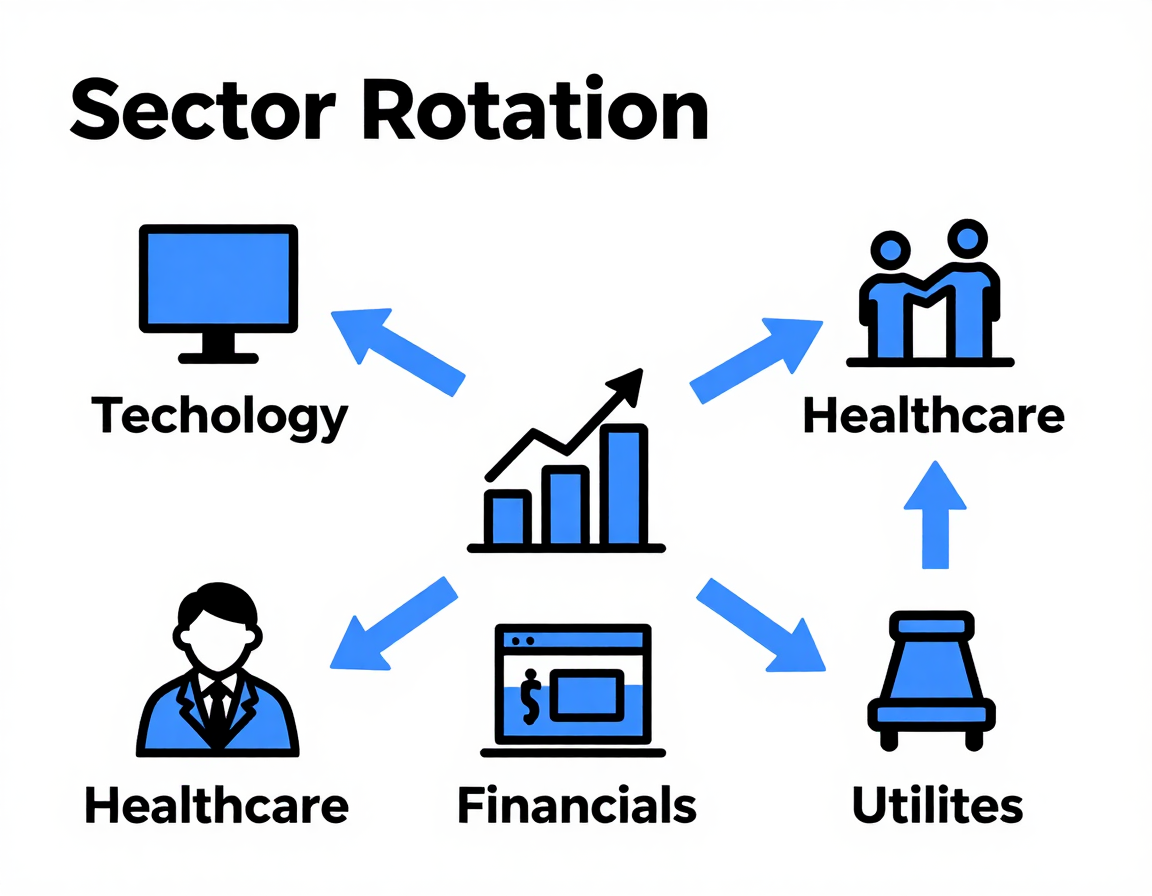
Rate cuts in 2026 will likely trigger measurable shifts in sector leadership. Technology stocks, which have driven equity market gains over the past year through artificial intelligence investment and productivity gains, may face headwinds if rate cuts reflect economic weakness rather than sustainable growth. However, if rate cuts occur alongside stable economic growth, technology stocks could continue to benefit from lower discount rates applied to their future earnings streams.
Growth-oriented sectors including consumer discretionary and communications should benefit from lower borrowing costs and improved consumer purchasing power. Rate cuts reduce monthly mortgage payments and auto loan costs, supporting consumer spending on discretionary items. Healthcare stocks, which offer stable earnings and dividend yields, may attract investors seeking income as bond yields decline.
Financials represent a key sector to monitor. Lower rates compress net interest margins, reducing bank profitability. However, if rate cuts reflect economic weakness, financial stocks may decline further as credit quality concerns emerge. Regional banks and mortgage lenders face particular pressure in a lower-rate environment, though large-cap financial institutions with diversified revenue streams may prove more resilient.
Utilities and real estate investment trusts, traditionally defensive sectors, may face valuation pressure as their dividend yields become less attractive relative to declining risk-free rates. However, their absolute stock prices could appreciate if the economic backdrop deteriorates significantly. Energy stocks may benefit from stable or rising oil prices if geopolitical tensions persist, as noted in recent market commentary regarding war-related inflation risks.
Investors should consider that sector rotation is not instantaneous. Market leadership typically shifts gradually as economic data accumulates and Fed policy becomes clearer. The uncertainty surrounding tariff policy, Fed leadership transitions, and geopolitical developments creates additional volatility that may delay or accelerate sector rotation patterns.
5) The AI Boom Factor: Downside Risk to Rate-Cut Expectations
A critical wildcard in the 2026 rate-cut outlook is the sustainability of the artificial intelligence investment boom. Morningstar’s Caldwell identifies an abrupt deflating of the AI boom as a factor that could cause the Fed to cut rates more aggressively than currently expected. AI has contributed the lion’s share of GDP growth over the past year, both through direct business investment in AI infrastructure and indirectly through stock market gains that have supported consumer spending.
If AI investment disappoints relative to current expectations, or if productivity gains fail to materialize as anticipated, corporate earnings growth could decelerate sharply. This scenario would likely force the Fed to cut rates more aggressively to offset the negative impact on aggregate demand. Caldwell’s forecast of five total rate cuts through 2027, compared to the Fed’s guidance of just two, reflects concern that economic growth may slow more than the Fed currently anticipates.
For equity investors, this scenario presents significant downside risk. Technology stocks, which have benefited most from AI enthusiasm and have driven overall market gains, would likely face the sharpest declines in an AI disappointment scenario. Growth stocks more broadly would suffer as earnings estimates are revised downward and discount rates applied to future earnings remain elevated despite Fed rate cuts.
Conversely, if AI investment continues to deliver strong productivity gains and earnings growth, the Fed may cut rates less aggressively than some forecasters expect. In this scenario, technology and growth stocks could continue to outperform, and sector rotation away from growth may be limited. The divergence between Morningstar’s forecast of five rate cuts through 2027 and the Fed’s guidance of just two cuts reflects this fundamental uncertainty about the AI boom’s sustainability.
6) Practical Portfolio Positioning for a Rate-Cut Environment

U.S. investors should approach 2026 with a portfolio strategy that balances exposure to sectors likely to benefit from rate cuts while maintaining diversification against downside risks. A core-satellite approach offers one practical framework. The core portfolio should maintain broad market exposure through diversified equity index funds or exchange-traded funds, capturing overall market gains while minimizing the risk of being wrong on sector rotation timing.
Satellite positions can be tilted toward sectors expected to benefit from rate cuts. Growth-oriented sectors including technology, consumer discretionary, and communications offer exposure to companies with earnings concentrated further in the future, which benefit most from lower discount rates. However, investors should size these positions carefully, recognizing that rate cuts may reflect economic weakness rather than sustainable growth acceleration.
Defensive positioning should include exposure to healthcare, utilities, and consumer staples sectors, which typically outperform during economic slowdowns. If the labor market weakens more than expected or the AI boom disappoints, these defensive sectors could provide portfolio stability. Real estate investment trusts and dividend-focused equity strategies offer income generation, though investors should recognize that dividend yields become less attractive as bond yields decline.
Fixed income positioning deserves careful consideration. If the Fed cuts rates as expected, bond prices will appreciate, providing portfolio diversification benefits. However, investors should avoid extending duration excessively, as inflation risks remain elevated and Fed policy could shift if economic data surprises to the upside. A barbell approach combining short-duration bonds with longer-duration bonds offers flexibility to adjust positioning as economic conditions become clearer.
International equity exposure provides diversification benefits, though currency movements will be influenced by Fed policy. A weaker dollar resulting from U.S. rate cuts could benefit U.S. investors holding foreign stocks. However, geopolitical risks and varying monetary policy paths across developed markets create additional complexity that requires careful monitoring.
Investors should establish clear rebalancing disciplines and avoid making dramatic portfolio shifts based on short-term market movements or Fed communications. Rate cuts typically unfold gradually, providing multiple opportunities to adjust positioning as economic data accumulates and market leadership becomes clearer. Regular portfolio reviews, ideally quarterly, allow investors to assess whether their sector tilts remain appropriate given evolving economic conditions.
How to Apply This in Practice
Monitor Fed Communications and Economic Data: Track monthly employment reports, inflation readings, and Fed meeting decisions. Use these data points to assess whether rate cuts are occurring because growth is accelerating or because the economy is weakening. This distinction is critical for determining which sectors will outperform.
Assess Your Current Sector Exposure: Review your portfolio’s sector allocation relative to the broad market. If you are significantly overweight technology or growth stocks, consider whether you have adequate diversification into defensive sectors that may outperform if economic growth disappoints.
Evaluate Your Fixed Income Strategy: If you hold bonds, recognize that rate cuts will drive price appreciation. Consider whether your bond duration is appropriate for your risk tolerance and time horizon. Shorter-duration bonds offer flexibility to reinvest at higher yields if rate cuts pause.
Consider Dollar-Cost Averaging Into Sector Tilts: Rather than making large, concentrated bets on specific sectors, gradually build positions over time. This approach reduces the risk of buying at market peaks and allows you to benefit from market volatility.
Establish Clear Exit Criteria: Define the economic conditions or market signals that would prompt you to reduce sector tilts or shift to more defensive positioning. This discipline prevents emotional decision-making during market volatility.
Review Your Dividend Strategy: If you rely on dividend income, recognize that lower rates may reduce dividend yields on some stocks. Diversify across sectors and consider whether your dividend portfolio remains appropriately positioned for a lower-rate environment.
Risk Note
This analysis is based on forecasts and expectations that may not materialize. The Federal Reserve may cut rates more or less than currently expected, depending on inflation developments, labor market conditions, and unexpected economic shocks. Tariff policy, geopolitical developments, and Fed leadership transitions create additional uncertainty that could significantly alter the rate-cut trajectory and equity market leadership patterns discussed in this article.
Sector rotation is not guaranteed, and historical relationships between interest rates and sector performance may not hold in all economic environments. Technology stocks could continue to outperform even if rate cuts reflect economic weakness, or they could underperform if rate cuts occur alongside strong economic growth. Individual investors should consult with qualified financial advisors before making significant portfolio changes based on rate-cut expectations. Past performance does not guarantee future results, and equity investments carry inherent risks including the potential loss of principal.